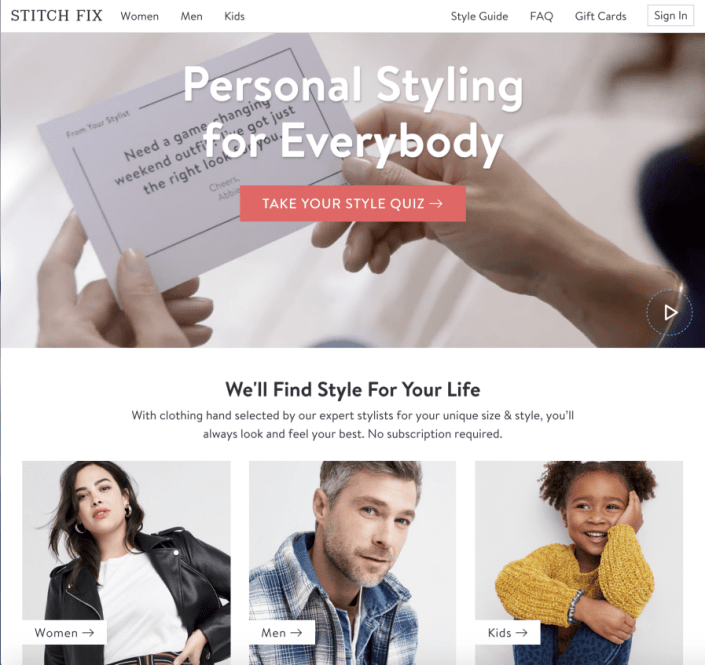
In 2011, Katrina Lake and Erin Morrison Flynn founded Stitch Fix. Their original idea is to provide people with personalized styling services online. Stitch Fix is a distinctive e-commerce company and it proves that humans can indeed build a better fashion retail business by data-power(Bercovici, 2017). Unlike traditional fashion retailers, Stitch Fix matches an excellent team of designers with a large amount of data to provide customers with personalized styling services online. Although Stitch Fix is a young company, it has achieved great success. As the company’s business continues to grow, Stitch Fix has achieved revenue growth of more than 20% for seven consecutive quarters since 2017(Turner, 2019). Today, Stitch Fix has grown from a start-up to a billion-dollar public company. And as of 2019, the company’s market value has reached $ 2.4 billion(PYMNTS, 2019).
How Stitch Fix Works?
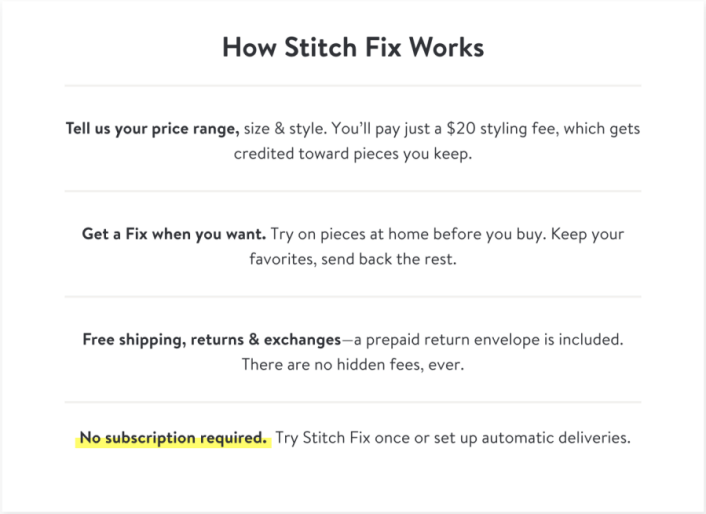
The customer’s personalized information is an important basis for Stitch Fix work, so the collection of customer information is the first and most important step in the entire service process. Stitch Fix provides a style profile on its own digital platform (both online and mobile) for customers to fill in to understand customer needs and wants such as customer preferences for fashion, price requirements, style, etc.
In addition, it also provides an optional feature that allow you to share your social media such as Instagram, so that your stylist can further understand your personality and style. After completing this step, Stitch Fix will uses digital technology(such as artificial intelligence and algorithms) to analyze the information provided by the customer and sent the results to the matching stylist, and then provide the customer with high-quality personalized styling services.
Stitch Fix business model
In fact, the business model of Stitch Fix is very simple. The stylist of Stitch Fix selects and sends clothes and accessories for the customer based on the result from data science and algorithm, and then the customer can keep the favorite items and return the others(Lake, 2018).
And customers only need to pay for the items they decide to keep. Each time Stitch Fix will send customers 5 items and charge a $ 20 styling fee(Chen, 2019). The key to Stitch Fix’s business is to combine data science and professional designers to achieve large-scale customized services.
Data science is a powerful tool for Stitch Fix
Data science is the core of Stitch Fix’s business. Although Stitch Fix is not a company in technology industry, it take data seriously and uses it to improve customer experience and retail.
First of all, Stitch Fix is hungry for more data. From the beginning of the service, it collects some key information (i.e. data) of the client through style profile. And by letting customers browse the different styles throughout the product line, it can collect a lot of data to help it better understand customers and the age and demographic trends shaping the fashion industry(Newman, 2019).
After obtaining a large amount of data, Stitch Fix made full use of this data and transformed them into useful information to provide a correct direction and basis for their business development. Machine learning algorithms are an important analysis tool for Stitch Fix. Through the algorithms built by Stitch Fix data science team, intelligent machines can dig deeper into the true needs of customers(Duczeminski, 2019). The intelligent machine can give the ‘matching score’ between the customer and a specific piece of clothing through algorithms.
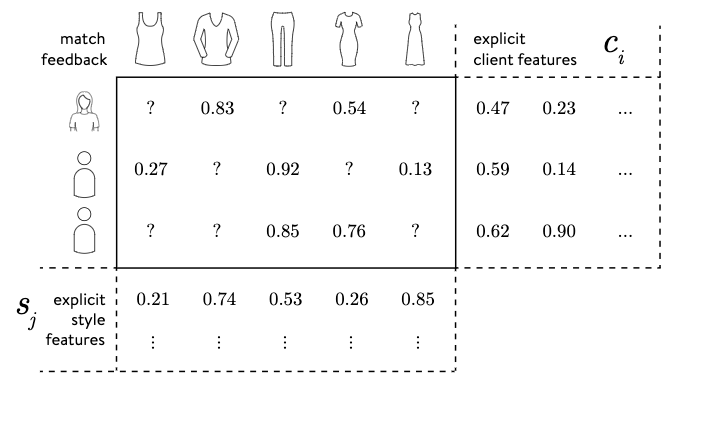
With machine learning algorithms, the stylists can understand the needs of customers more scientifically and accurately rather than predicting by intuition alone. In addition, Stitch Fix not only uses data science to choose fashion for customers, it also applies data to company operations, style design, sales, inventory management, distribution, warehouse optimization(Li, 2020).
The combination of data science and human judgment
There is no doubt that data is critical to Stitch Fix, and so is human. After the machines and algorithms have completed the initial screening process, Stitch Fix hires professional human stylists to make decision for the final product delivery. The prefect combination of data science and human judgement is the core of Stitch Fix work, human stylists are key to understanding the nuances of a client’s requirements and ensuring their experience is personal(Gagliordi, 2018). For example, if a client makes a very specific request such as “I need a quick-drying sportswear to participate in sports next week”, after getting this information, the stylist can quickly find the right clothes for the client from the alternative box.
According to Hollis(2018), Stitch Fix’s “people-oriented” approach transforms artificial intelligence into intelligent augmentation, rather than letting machines completely replace humans. As Lake(2018) said that a good person working with a good algorithm is far better than the best person or just the best algorithm.
To sum up, Stitch Fix is an outstanding company that makes full use of the advantages of data science and humans and combines them well to achieve large-scale personalized services. More importantly, it proves that intelligent machines do not replace the work of professionals, but rather assist them and improve their efficiency.
References
Bercovici, J. (2017). How This Millennial Founder Created a $730 Million Fashion Startup–With the Help of an Algorithm. Inc. Retrieved from https://www.inc.com/magazine/201710/jeff-bercovici/stitch-fix-katrina-lake.html
Chen, C. (2019). he evolution of Stitch Fix: from a Harvard student’s apartment to a $2 billion company. Business Insider. Retrieved from https://www.businessinsider.com/stitch-fix-personal-styling-overview?r=US&IR=T
Duczeminski, M. (2019). How Stitch Fix Uses Data to Increase Sales and Engage Customers. Retrieved from https://postfunnel.com/how-stitch-fix-uses-data-to-increase-sales-and-engage-customers/
Gagliordi, N.(2018). How Stitch Fix uses machine learning to master the science of styling. Retrieved from https://www.zdnet.com/article/how-stitch-fix-uses-machine-learning-to-master-the-science-of-styling/
Hollis, S. (2018). The Stitch Fix story: changing the way millions of people dress with data. Retrieved from https://jilt.com/blog/stitch-fix-data/
Lake, K. (2018). Stitch Fix’s CEO on Selling Personal Style to the Mass Market. Harvard Business Review. Retrieved from https://hbr.org/2018/05/stitch-fixs-ceo-on-selling-personal-style-to-the-mass-market
Li, S. (2020). The Stitch Fix Story: How A Unique Prioritization Of Data Science Helped The Company Create Billions In Market Value. Forbes. Retrieved from https://www.forbes.com/sites/stevenli1/2020/02/17/stitch-fix-data-science/#53fe7f2f6023
Newman, D. (2019). Stitch Fix: A Useful Case Study For Retail’s Digital Transformation. Forbes. Retrieved from https://www.forbes.com/sites/danielnewman/2019/09/09/stitch-fix-a-useful-case-study-for-retails-digital-transformation/#44ec3a87d4c9
PYMNTS. (2019). Stitch Fix: Big Growth And A Surprise Turn To Profitability. Retrieved from https://www.pymnts.com/news/retail/2019/stitch-fix-earnings-revenue/
Turner, A. (2019). Stitch Fix spikes after beating earnings and revenue expectations. CNBC. Retrieved from https://www.cnbc.com/2019/06/05/stich-fix-q3-2019-earnings.html
 Green's Blog
Hi Wang,
As you said, the most important foundation of Stitch Fix in this e-commerce is to collect personalized information of customers. In fact, in today’s era, businesses that can accurately locate customer needs and provide them are able to gain a foothold in the market, because of carrying on network sale now, the brand of electronic marketing is no longer a few, but the brand that can provide professional and custom-made modelling collocation service for the customer is few. Therefore, I think one of the reasons for Stitch Fix’s great success in the e-commerce is that when customers have demand for clothing, the brand can accurately locate customers’ psychological price, brand style and what they need. For the most part, compared with physical stores, e-commerce doesn’t take the form of face-to-face communication, but online communication. How to receive customer feedback online accurately is a problem.
LikeLike